Article in the Times Herald of PA
Local effort devoted to Feeding Pets of the Homeless
By GARY PULEO
LOWER PROVIDENCE — If you suddenly found yourself homeless what would you do with your dog or cat?
Would you dump your best friend off at the SPCA and say goodbye forever? Or would you decide that you want your devoted companion by your side through the good times and the bad times, no matter what?
As many as one quarter of homeless people own pets, according to Pets of the Homeless, an organization based in Carson City, Nev. that has collected more than 76 tons of pet food and supplies for homeless shelters, food banks and soup kitchens across the country since 2008, while also making sure that pets of the homeless have access to veterinary care.
The initial reaction of Pets of the Homeless volunteer Christine Davis, who lives in Skippack, was typical of many people when they become aware that people without a place to call a home can still choose to have a furry companion in their lives.
“I got inspired to get involved after visiting Center City two years ago and seeing homeless people in the Rittenhouse Square area that had dogs, and I was shocked,” Davis said. “I used to work in Center City 20 years ago and had never seen that before. I just felt compelled to do something, so I started doing research and found Feeding the Pets of the Homeless. There was nobody actively doing anything in this area for them.”
Her crusade to feed and care for the pets of the homeless has led Davis to food banks and other places that seem to have a lot to offer the humans they encounter every day, but little to provide for the dogs and cats that were either accompanying them or off in the background going unnoticed.
“I work part-time and call this my other part-time job,” said Davis about her passion. She keeps detailed inventories on the food collections, maintains e-mail lists and is frequently found at community events, such as Perk Valley Pet Eatery’s Dogs Night Out at the Park.
“These events help me get the word out so people realize there’s a need,” Davis said. “When people donate food to a soup kitchen they don’t realize some of these people have pets and they want to keep them.
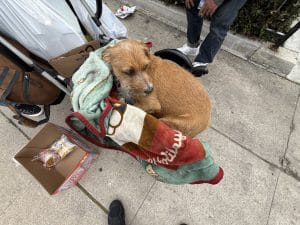
“I always get that reaction: ‘Oh wow, I never thought about that.’ But I always get positive feedback,” she added, “with people thanking me for what I’m doing. Most people are sympathetic. These are animal lovers who can’t imagine being without their pets. I have pictures of homeless people with pets on my poster board and people say they’re too sad to look at. But to me it’s showing something beautiful, a bond between people and their pets.”
Davis has volunteers who help her repackage a lot of the pet food, which is then distributed to nine locations, including the food pantry at her church, Branch Creek Community Church in Harleysville.
“I try to share the food and spread it around with anyone who has a need,” Davis noted. “Most of the food goes to food pantries and soup kitchens in the area.”
Last year, Davis collected more than 10,000 pounds of dog and cat food.
On Tuesday nights she’s often joined at the Heart of God Church soup kitchen in Pottstown by Sherri Schilingo, a receptionist at Trooper Veterinary Hospital in Lower Providence, who became a volunteer when the women met at a “dog event” in Trappe.
“I wasn’t aware of the homeless pets problem, but when I met Christine and she told me about it I knew it was something I wanted to help with,” said Schilingo, who quickly began organizing pet food drives and brought her employer on board as the storage facility for the collected food, toys, treats and bedding, which is then transported to food pantries such as Open Door Ministries in Royersford.
A Pets of the Homeless — also known as Feeding Pets of the Homeless — flyer encouraging donations is displayed in the animal hospital’s lobby.
“Trooper Vet allows me to collect food and store it here and put messages on their Facebook page, plus send e-mails to clients. Most of the people coming to Trooper Vet care about animals, so it’s not a hard thing to get them to help out,” Schilingo said.
She shares a portion of the bounty with Montgomery County SPCA.
Schilingo and Davis are trying to convince soup kitchens in Norristown, where they estimate the homeless rate may be comparable to Pottstown’s 20 percent, to work with them in feeding homeless pets but aren’t having much luck, Davis confided.
The Heart of God soup kitchen is one of the few places where Davis gets to actually meet homeless folks and talk to them about their pets.
“They don’t bring their pets with them, so I don’t get to see their dogs and cats,” she said. “A lot of them live in Tent City, which is basically a place in Pottstown where people put up tents. A lot of them do have housing, but it’s much lower income, subsidized housing.”
LOWER PROVIDENCE — It’s not something even the most passionate animal lover often thinks about, but up to one-quarter of homeless people own a dog or a cat.
Genevieve Frederick did more than think about it.
In 2008 the Carson City, Nev. woman started Pets of the Homeless, which has since collected more than 76 tons of pet food and supplies for homeless shelters, food banks and soup kitchens across the country, while also making sure that pets of the homeless have access to veterinary care.
Locally, the national outreach, which eventually hopes to establish a presence in every state, couldn’t have two more zealous volunteers than Christine Davis and Sherri Schilingo.
With their primary mission focused on keeping homeless pets fed and humanely treated, both women continually make a valiant effort in trying to counsel homeless people about what is best for their pets.
“There are mixed emotions about it. I don’t know their personal history and how they came to be homeless,” said Schilingo, a receptionist at Trooper Veterinary Hospital in Trooper, where she stores most of the pet food she collects. “Some of them are just down on their luck. They were doing OK before they lost their job, or medical issues and different things came up. The ones who are open to listening, I definitely try to talk to them.
“Some don’t think that what they’re doing isn’t ideal. It comes down to opinion. It’s hard to tell them what a pet needs and it’s going to cost them ‘x’ amount of money when they don’t have enough food for themselves.”
Schilingo admitted she has helped a woman with veterinary care out of her own pocket.
“I am helping her with her cat, who had a litter of kittens, then another litter. And I said ‘why don’t we get one of them neutered?’ Ideally you want both neutered. so I helped her get the male cat neutered. Not what I would call an ideal situation. When you pay less for something like that, you get less quality care. But if that’s all you can afford that’s what you have to work with. There is a state law for rabies vaccines and they can be fined for it if that’s not up to date, but unfortunately if there’s not some kind of abuse going on, it’s not illegal to have a pet you have a hard time taking care of.”
A pet owner who spent money on a frivolous cosmetic procedure for her dog recently elicited the anger of the volunteers, recalled Davis, who lives in Skippack.
“This woman, who is not homeless and lives with her mother, has six dogs — five pit bulls and a King Corso. These are big dogs who eat a lot. And she said she just got the one dog’s ears clipped, which is completely cosmetic and expensive, and she could have used that money to buy dog food. These animals still have to eat and it’s not their fault their owners are making very bad decisions. If these people weren’t trying to take care of them they’d be in a shelter or wind up on the street. It’s a really hard thing. I don’t have a problem telling people what I think.”
Not abandoning a pet when an individual is suddenly left without a home is a trait many animal lovers will admire.
But one point of departure that leaves some folks baffled is when people continue to adopt pets after they’ve become homeless.
“I can’t really judge people for what they do … it’s just hard for me to understand,” Schilingo said. “There are different mindsets at work.”
On the phone from the group’s headquarters in Nevada, Genevieve Frederick noted: “If a stray dog comes up to a homeless man on the street and decides that’s going to be his new owner, so be it. I have no control over that. But if that pet needs help we would certainly help him because that’s our mission.”
With its limited funds, Pets of the Homeless works tirelessly to get pets access to veterinary care, generally on a bus route that is convenient to a homeless individual.
The group has also given grants to veterinarians who go out to where the homeless congregate to organize wellness clinics for pet vaccinations against all manner of diseases.
“If you have a homeless person who is working with a social worker, or just a homeless person on the street with a dog who needs medical care, if that person will advocate for that homeless person and give us a call to say ‘Here’s the situation, can you help this dog or cat?,’ we will say yes. There are animals that we just can’t help — with cancer or diabetes or elderly — because we are so stretched with funds. But we don’t want the dog to suffer so we will pay to have the animal put down. I know it’s hard for people to accept sometimes, but when they’re elderly and suffering, it’s just the right thing to do.”
Usually, being homeless is a short-term situation for most people, Frederick pointed out. “Sometimes people are homeless for just a month or two until they get that next job. They may have enough to stay in a motel for a couple of weeks. We got a call from a man who was homeless and living in his car with three little dogs and we helped find a place that would board his dogs at a very reduced price for two weeks because he knew he had a job and knew he was going to be getting into a motel that would allow dogs. He just needed these dogs to be somewhere safe and out of the heat and out of his car while he was working. Sometimes people just need a little help until they can get back on their feet so that they don’t lose these precious companions.”
A lot of homeless don’t understand that if they took their animal to a shelter they could request that the animal not be adopted out or put down for a number of days, Frederick added.
Carmen Ronio, executive director of Montgomery County SPCA, noted that the SPCA will provide temporary housing for an animal for up to seven days.
“We’re not a boarding facility, but there are hardship cases where we can offer housing at no cost for seven days if an animal has no place to go, and sometimes longer depending on the population here,” he said. “A lot of times it’s due to spousal abuse, or being evicted with short notice. But we would be concerned about placing a dog back on the street with a homeless person.”
Frederick’s goal is for homeless shelters to wake up to the fact that their clients often have pets that need shelter too.
“Unfortunately, many of these homeless shelters won’t allow pets. There are so few across the country that will allow pets that we are trying to bring awareness to homeless shelters of the importance of this. So we have said if any homeless shelter will let us know that they will allow pets but they need collapsible crates so that the dog can stay next to their owner, where they can get out of the snow and the rain, we’ll ship the crates to that shelter,” she explained. “Once they see the benefit of letting the person keep their pet — because there are physical and mental benefits — and they go through the regulations to make their homeless shelter be a shelter that allows pets we will help them.”
The week of Aug. 7 to 13 has been designated as the second National Feeding Pets of the Homeless “Give a Dog a Bone” Week.
Donations of pet food can be taken during hours of operation to one of the local collection sites: Trooper Vet, 7 Park Avenue, Lower Providence; Pet Valu, 2650 Egypt Road, Audubon; the Urban Hound, 1639 W. Main St., Trappe; Perk Valley Pet Eatery, 325 W. Main St., Trappe; Floral & Hardy, 4007 Skippack Pike, Skippack; Charlene’s Pet Services, Skippack; Bark Avenue, Shelly Square Shopping Center, Harleysville and Pabby’s Pet Pantry, 319 W. County Line Road, Hatboro.
Contact Christine Davis at 610-247-3421. For more information on Pets of the Homeless, visit www.petsofthehomeless.org.