I don’t think I know anyone who counts living on the streets as one of their goals. Sure, it’s easy to lament the cost of rent, the annoyance of housework, and the never-ending string of chores — but if someone was given the option to forego all those “inconveniences” and just live without a house, I’m willing to bet they would stay right where they are.
Homelessness: The Stigma
Living without shelter or a stable environment is trying, but when you factor in the almost complete disregard targeted at someone experiencing homelessness, the situation escalates. Our homeless populations are overlooked, underserved, and unfairly stigmatized.
To those blessed with necessities, a destitute citizen who calls the street their living room may be repulsive, threatening, or even deserving of how little they have. There’s an overarching narrative in society that says the homeless are to blame for their own situation. People living in the street are generally seen as dirty and dangerous, and we tend to avoid them, rather than reaching out a helping hand.
In reality, their stories may be wildly different than what’s assumed. Some are victims of addiction who can’t afford or access care. Some are parolees with nowhere to go upon release. Some are plagued by mental illness, but don’t have access to the medical care they need. Up to 50,000 of America’s homeless are veterans. Others still are families fallen on hard times or elderly with no one left to care for them. Some of the homeless are people exactly like you, who took one more unlucky blow than they could withstand.
In reality, none of us are immune. How many of us could comfortably survive getting laid off and being unable to find a job? What about a major medical expense? A Gallup poll found that 11.3 percent of Americans started 2017 without insurance. Even with insurance, medical bills can create an irrecoverable financial strain. Losing work with a chronic illness or in a paycheck-to-paycheck situation can result in homelessness.
Few of us are so financially and socially secure that homelessness is a complete impossibility.
It’s the Little Things — or the Furry Ones
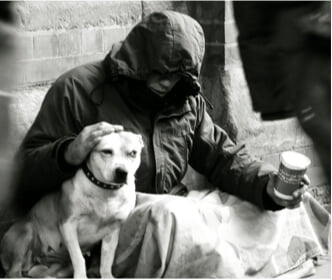
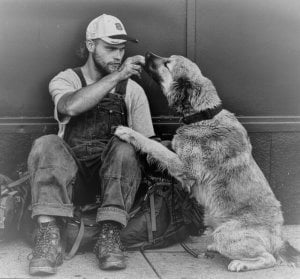
People experiencing homelessness are often further criticized for having animals with them. Passerbys wonder — to themselves or out loud — how a person can take care of an animal when they can’t take care of themselves.
Judgments on a homeless individual’s choices perpetuates the belief that they are somehow less than housed people. However, making assumptions that animals are ill-cared for is often far from the truth. James, a homeless man in Portland, OR, expresses that, “Sometimes there’s not enough for the both of us that day. But I make sure she always eats. She has to.” Bigera, his dog, has been with James for nearly four months.
The sentiment is echoed by most who are interviewed. The homeless do their best to provide adequate food, exercise, and veterinary care even if it means sacrificing the few dollars they saved for their own medical care. Homeless individuals with pets prioritize the health and nourishment of their animals the same way those with housing care for their animals.
And in the same way that pets provide comfort to their owners within the confines of a dwelling, so do the animals of those forced to the streets. Their pets become their most loyal, and usually only, companions. Animals do not judge, and they cannot distinguish between an employed or an unemployed person. They just know who loves them, feeds them, and stays with them — and the animals return that love in spades.
Pets of homeless individuals provide more than just love, though. Having a dog with you while living on the street can mean protection, warmth, and a reason to keep going every day. When a person has lost everything, their pet may be the only connection they have left.
Updating the Fight Against Homelessness
Maintaining the connection between person and pet is of the utmost importance; being separated from a pet can be traumatic and psychologically harmful to the owner. Wherever they are able to be with their pet is where they feel most “at home.”
Rachel Kurzyp spent several months homeless when she was 17 — not because she lacked shelter, but because “a home is more than four walls and a roof: it’s a space where you have security and privacy, where you feel safe and have control over your living space.”
Removing a pet from a homeless individual is removing their sense of security. Not having a house is one thing, but to lose your sense of connection entirely is another. Houselessness is far easier to cope with when there’s an animal to keep you company.
Housing-first solutions are important in the fight against homelessness, but what is overlooked is that many people won’t accept the shelter if it means surrendering or abandoning their pet. Bob Brokaw of Corvallis, OR, won’t leave his dog just for a warm bed. “I’m not getting rid of my dog to go indoors,” he said, “I’ll just bundle up.”
Many individuals who live on the streets with their pets feel the same way. While the vast majority of shelters don’t allow pets in with residents, some areas are finding workarounds or are starting to see the light.
If we want to help the houseless residents of our streets into a better situation, we must consider that their animals are their family, and they will never feel at home without them.