
©Feeding Pets of the Homeless
A FEW DAYS AGO I was driving along a frontage road near a busy intersection, when I passed a woman and her dog sitting on the curb. The woman was holding a cardboard sign, hand-scrawled with the message that’s become all too common around town these days: “Please help.”
I took a u-turn and parked across the road from them, rummaged through my pockets for what little cash I had on hand, and got out.
The woman looked to be in her thirties, maybe forty, with shoulder-length blond hair, wearing a t-shirt and Army green cargo pants, with a water bottle and a backpack lying beside her. Her pup, a young, lean, timid thing with a sleek clean coat the color of the woman’s hair, eyed me nervously.
“That’s a pretty dog.” I said.
“She’s an angel,” said the woman. “That’s her name—Angel. I just found her a couple weeks ago. You should have seen her. She was so scared. And nothing but bones. But look at her now.”
“She’s beautiful,” I said.
“I used to be a nurse,” she said proudly. “I know how to take care of her. Don’t I, Angel?”
The woman softly stroked her Angel’s neck and brought a little grin of contentment to the dog’s lips.
I reached across and meekly offered my money. “Will this help?”
“Bless you,” she said. She turned to comfort Angel, still warily eyeing the stranger. “Angel, it’s okay baby.”
Soul Mates
At any one moment there are between five hundred thousand and three and a half million people living homeless in the United States. Beside them sit perhaps half a million dogs or cats as their closest companions. Tens of millions more of these couples are living together in poverty, just one layoff, one medical bill, one eviction away from the streets themselves.
The numbers blur the hard realities. For every one of those millions there’s a face, a name, and a story that render such statistics unfathomable, unallowable. And so my encounter with Angel and her person has been rightly weighing on me ever since. It has had me questioning my own lucky station in life, with my piddly little tokens of help. There but for the grace of God go we?
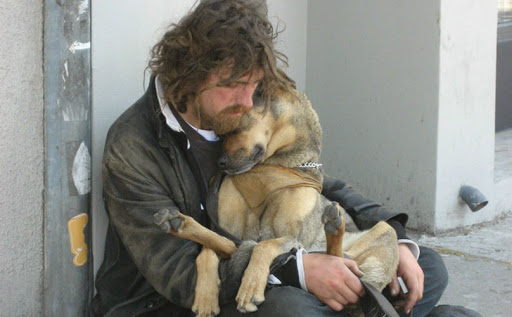
There was a time not long ago when I might have looked on with pity as I passed those two. I might have viewed them as just another variant of the same unsightly spectacle we see with such numbing repetition, of the rheumy eyed bum and bedraggled dog sprawled upon the city sidewalk of America, a single blanket underpinning the whole of their worldly belongings. I might have subconsciously endorsed the stereotype, of the lazy, parasitic, drugged and drunken derelict, the poor dog so blatantly exploited as a panhandling prop.
But after more than a decade of living with a houseful of once homeless waifs and castoffs from the streets—albeit of the four-legged variety—for me there’s no more denying the hypocrisy behind the subhuman status we attach to the homeless of our own stripe.
There’s Nosey, the diminutive feral cat my wife finally coaxed inside our West Virginia home during a winter week of brutal sub-zero nights. ‘Feral cats can never be tamed,’ went the folklore. Within two months, little Nosey went from a hissing spitfire to the most affectionate, most cocksure queen of the whole bloated menagerie.
There’s Towpath, the pitbull we found as a four-month-old puppy, burned and beaten and tossed like trash on a country road. ‘Beware,’ warned the haters, ‘they have locking jaws and the biting force of a shark.’ Right. Towpath’s favorite pastime is to wiggle and waggle his way into strangers’ laps. Or to kiss infants in their strollers.
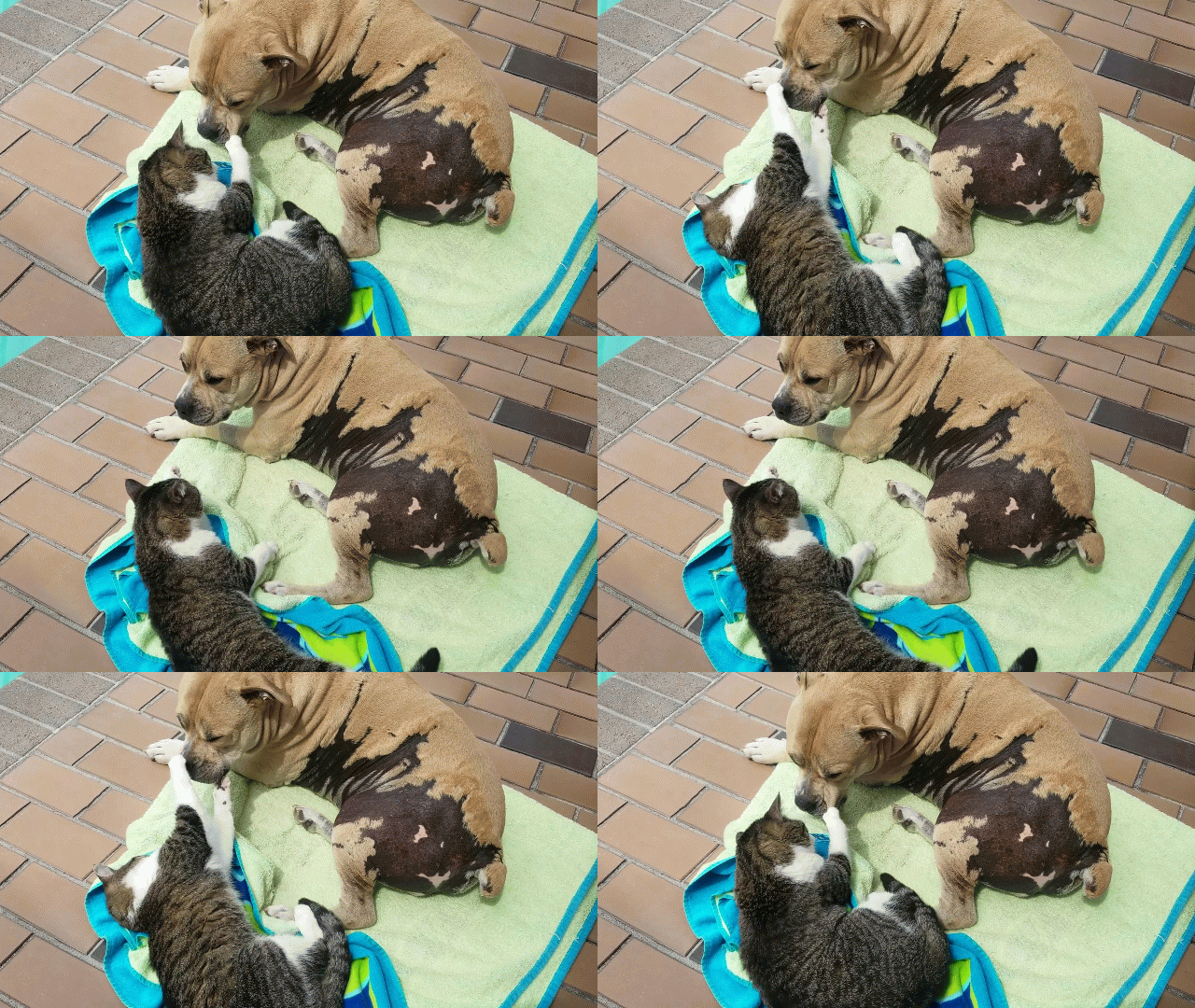
Street Ambassadors: Nosey and her dog, Towpath
Redemption
The evidence was literally beneath my nose—of the wrongness in our reflexive scorn for the homeless. As if they were inherently deserving of their struggles. As if we, simply by our wealth, were fundamentally superior companions to our animals.
And then there was the science. About ten years ago, Leslie Irvine, a professor of sociology at the University of Colorado, approached a man and his dog panhandling on the streets of Boulder. Out of sympathy for the dog, she offered to buy it. To which the man indignantly rounded on Irvine’s audacity, as if she had just offered to purchase his son. Irvine took her comeuppance to heart. She and her students would go on to interview some sixty homeless people and their furred companions, in Boulder, Sacramento, and San Francisco.
What Irvine discovered was a humbling world of bottomless compassion, dogged resilience, and heroic loyalty. She met a woman who for fear of losing her companion pup, had quit heroin and crack, cold turkey. She met people choosing to spend their nights out in the cold, because the shelters didn’t allow their dogs inside. She met suicidal people who, out of love for their dog, decided to live. Irvine published her findings in a series of academic papers, and a book whose simple title says so much: My Dog Always Eats First.
In retrospect, I’m pretty sure that title would go for Angel’s person as well. She would definitely eat last. I now regret that I didn’t pull up a seat on the curb and learn more of their story before driving off. It’s a gap I’m still learning to bridge. Theirs is a social territory where I naively tread as intruder, where hard questions beg harder answers. Whenever I think of that little family on the curb, I ask myself, ‘So why didn’t I invite them home for dinner?’
And I now look for them whenever I’m out, with hopes of soon answering, ‘Because I did.’