

The bond between people and their pets can be life-saving, especially amid the struggle for safe housing.
“First, my brother passed away and then my mother,” says Charles Jones, sitting on a blue metal folding chair in Philadelphia’s Breaking Bread Community Shelter. “I needed somebody to take care of. And I needed somebody to take care of me.”
Jones pauses and clears his throat, wiping his eyes. “I get emotional about it,” he says quietly, looking down at the black Labrador retriever sleeping at his feet. “Midnight has done so much for me. I really don’t know what I’d do without him.”
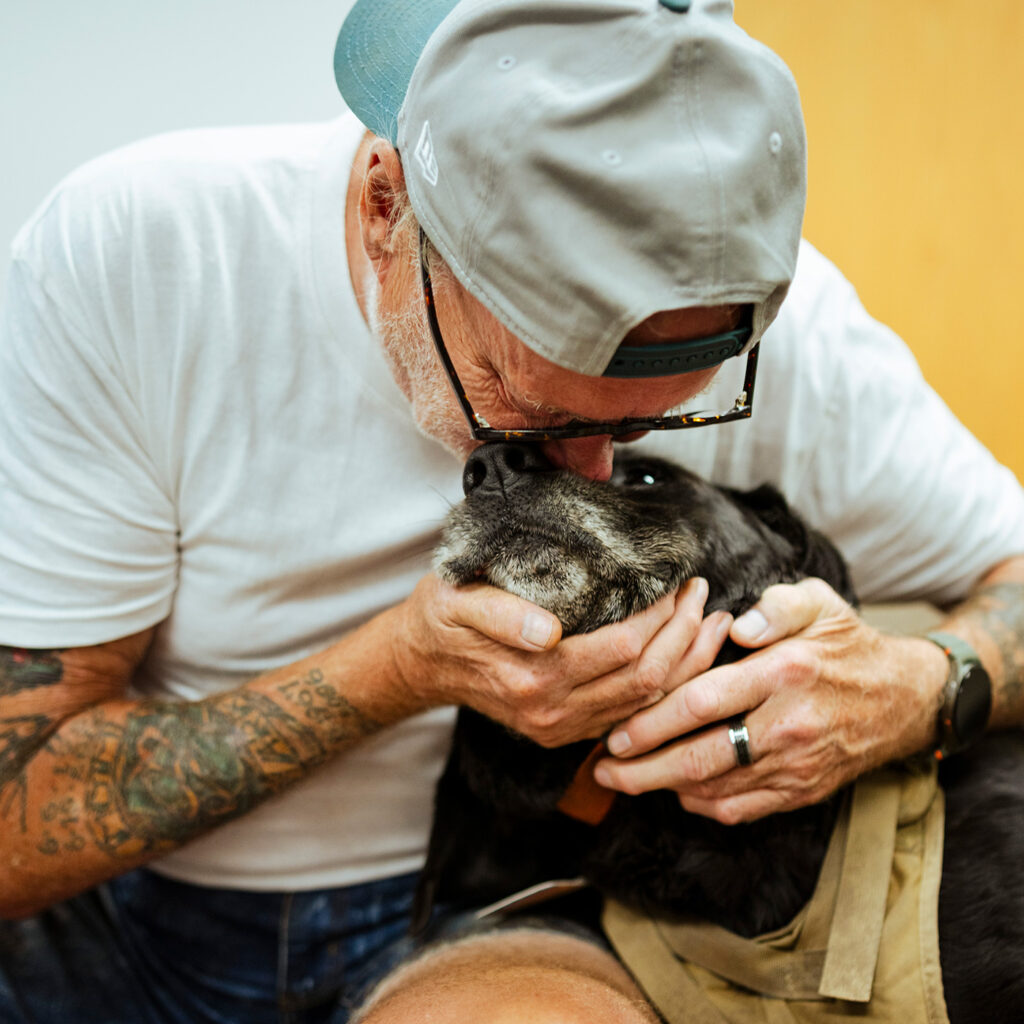
Breaking Bread Community Shelter serves individuals experiencing homelessness in Upper Darby, a township on the outskirts of Philadelphia. It is the only shelter in the area to welcome guests along with their “Three P’s”: pets, possessions, and partners of all genders.
A few years ago, Jones was in a car accident that left him unable to work. As a result, he lost his apartment and began living on the streets. During this time, Jones left his service dog, Midnight, in the care of a friend. Every day, for months, he would take the bus to visit Midnight.

In addition to his role as an emotional support dog, Midnight is also trained to care for Jones in the event of a medical emergency. Jones suffers from hypertrophic cardiomyopathy and relies on Midnight to bring him his medication and phone during cardiac episodes when Jones is unable to stand.

When Jones finally secured a spot at a shelter that allowed service animals, he found the staff to be confrontational about Midnight’s presence, despite the dog’s status as a service animal. Eventually Jones was evicted from the facility.
After sleeping in a storage unit for two nights, Charles and Midnight visited the Breaking Bread Community Shelter in search of food. They were immediately invited in for coffee and a meal. Soon after, Charles and Midnight secured a room in the shelter, shared with two other guests, and were able to move in.

“The first day we came, the staff called us by name, even Midnight,” Jones shakes his head, emotional once again. “They told me they had my back. I felt like I was in heaven.”
Once securing a bed at Breaking Bread, Midnight was given vaccines and other medical care from volunteer veterinarians in the community. “I owe this place everything,” says Jones. “We’ve got a whole new family here.”

An Impossible Decision
“Approximately 10% of people experiencing homelessness do so with service animals, emotional support animals, or companion animals,” according to the National Alliance to End Homelessness. However, very few homeless shelters currently accept pets. This means that many unhoused people are forced to make the often impossible decision between safe shelter and staying with their pet.
Additional research by the Alliance indicates that many choose to remain with their animal, even if that means sleeping on the street or staying in a violent situation. According to the Urban Resource Institute, “50% of domestic abuse survivors would not leave an abusive home unless they could take their pet with them.”
Biana Tamimi, a veterinarian and the director of shelter medicine at the Animal Care Center of New York City, believes this decision is only natural. Tamimi explains that for many people, an animal is more than a pet—they are a member of the family. Over her years of veterinary care in New York City, Tamimi has witnessed animals providing critical companionship, comfort, and trauma healing to people experiencing homelessness or poverty.

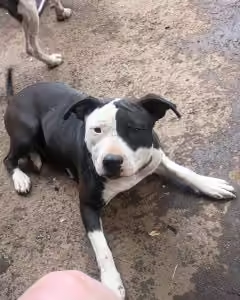
“Bam Bam has so many friends now. Everyone loves him,” Atkinson says, smiling. “I’m just grateful. I’m really grateful.”
“I have met so many unhoused people who say there’s no way on Earth they would give up their animal. [Their pet] is their reason to get up in the morning, a reason to go out and look for food,” Tamimi says. “We all know what it feels like to come home after a hard day and pet your cat or have your dog jump on your lap and give you licks. Imagine in the darkest time of your life, having a companion that’s been with you for years suddenly taken away. We never want that to happen to people.”

The Interconnected Health of Pets and their Owners
In addition to her role at the Animal Care Center of New York City, Tamimi serves as a co-lead at The Street Dog Coalition, an organization that believes the well-being of the pet and the owner are inextricably linked. At pop-up street clinics across the nation, the Coalition provides free veterinary care to pets of people experiencing or at risk of homelessness, while also offering social services and medical resources to owners. This model of care is known as the “One Health” approach. Attributed by many to 20th-century veterinary epidemiologist Calvin Schwabe, the One Health movement has gained popularity in recent decades.
“One Health is a way of providing care that recognizes the connection between human health and animal well-being,” Tamimi explains. “Practically, what these clinics look like is a veterinary team working alongside human health care providers. For example, I’ll be examining the animal, and maybe there’s a psychiatrist with us, and we’re having a conversation as a group.”
Tamimi shares that, often, the focus of the appointment is first on the pet, utilizing the human-animal bond to help the owner feel comfortable.
“People want their animals to get the care they need,” Tamimi says. “One of the biggest benefits [of One Health clinics] is getting someone through the door who might have a lack of trust with housing providers, with health care. … We use that bond with the pet to facilitate the human getting care for themselves as well.”
At a recent New York City pop-up clinic, Tamimi recalls a man who brought his cat to the clinic, concerned that she was developing asthma. Through conversation with the man, Tamimi and the volunteer social workers at the clinic discovered he was a heavy smoker, which was likely causing his cat’s breathing issues.
“That was a great opportunity to discuss how the owner could smoke a little less,” Tamimi says. “He didn’t realize his smoking was causing this problem, and he said he didn’t want to do that to her. … Our team was able to say, ‘Let’s tackle this problem together, because you’re going to be helping your cat and yourself.’”
To Tamimi, this illustrates the effectiveness of the One Health model and the power of the human-animal bond to positively influence a person’s life.
“Pets keep their owners grounded. They keep them well, especially in really dark times of isolation and stress,” she continues. “Humans can get through the most challenging times of their lives because they have an animal there with them that relies on them. … That interconnectedness is really valuable.”

In Texas, a Safe Space for Pets and Owners
The Bridge Homeless Recovery Center in Dallas is also working to keep unhoused people with their pets. The nonprofit has 20 dog kennels in its 750,000-square-foot center, along with shaded walking areas and a full-service grooming room. Recovery center clients are also provided with free dog food, leashes, and toys.
David Woody, a social worker and the president and CEO of The Bridge, says that in his experience, if a client is offered a spot in a shelter that does not welcome their animal, they often refuse services.
“Here at The Bridge, we’ve developed a real sensitivity to that kind of experience,” Woody says. “Through the kennel program, we offer dogs a safe space while the guest gets their needs met as well. We take care of the whole person, and the canine is just as important as anything else.”
Channon Cavazos, kennel manager at The Bridge, explains that often, guests open up to her about their trauma while talking about their pet. This allows the team at The Bridge to better serve the client’s individual needs.
Cavazos says there is nearly always a waitlist for The Bridge’s pet-friendly shelter services. In the coming years, she hopes to expand the kennel program, allowing more Dallas residents to receive shelter without being separated from their animal.
“There are people who will wait on our waitlist for weeks at a time because they can’t part with their animals. A lot of these people have been through a lot. The last thing they want to do is get rid of their animal,” Cavazos says. “I would love to see a kennel in all homeless shelters so that no one has to part with their animal to receive shelter.”

Mobilizing the Public
Feeding Pets of the Homeless, a nonprofit working across all 50 states, provides food and medical services to the animals of unhoused people. Since it got its start in 2008, the nonprofit has provided more than 2 million pounds of food as well as medical care to more than 30,000 pets.
“When we first started, our clients would tell us they were giving their pet half of whatever food they could find,” says founder Geneveive Frederick. “And we knew this wasn’t healthy for the person or the pet.”
Feeding Pets of the Homeless relies on donation sites across the country to collect pet food and supplies from the public. These donation sites are located in hair salons, doctors’ offices, pet shops, and other small businesses. The food and supplies collected then gets distributed by social service centers like domestic violence shelters and food banks. Feeding Pets of the Homeless also offers financial support to unhoused clients whose pets need urgent medical care.
The majority of the organization’s clients are women, Frederick shares. She highlighted that, many times, unhoused women are at greater risk of violence and rely on their animals for safety.
“Even the smallest dog can alert them that danger is coming,” she says.
Additionally, she mentions the high suicide rates among people experiencing homelessness. For some people, pets can provide a reason to seek help, even when they feel hopeless.
“For many [unhoused people], they’ve lost all hope … but they reach out to us because they feel responsible for their animal,” Frederick says. “Programs like ours can give people hope that somebody out there wants to help them, and their pet, in their time of need.”